Monday, 18 August 2014

Excitement over a new Spinosaurus aegyptiacus mount.

Spinosaurus: Lost Giant of the Cretaceous

National Geographic writes:" It was the largest predatory dinosaur, with spike-shaped teeth and a body over 50 feet long.“It” was Spinosaurus, and although it was a giant among dinosaurs, its fossils eluded scientists for decades. Now two dedicated paleontologists, Paul Sereno and National Geographic 2014 Emerging Explorer Nizar Ibrahim, are reconstructing a complete skeleton of this prehistoric giant that was bigger than T. rex.... "
The event (with the main attraction: presentation of the new mount) will be at the National Geographic Museum in Washington, D.C. in October 2014.

About 14 years ago. I wrote an article on Spinosaurus in the Japanese dinosaur  magazine.
Enigmatic Spinosaurus  Text & Illustration by Berislav Krzic

It is interesting that some of my  assumptions and conclusions regarding the strange anatomy of spinosaurids still stand. See some of my drawings below.

  Any interested enthusiast and professional should obtain the magazines, which are still available at the bargain price.

The premier dinosaur magazine from Japan! The Dino Press periodical series was published in 2000 - 2002. Contains information about dinosaurs, pterosaurs, marine reptiles, and a variety of extinct animals from past geologic time periods. Well-known paleontologists, illustrators, and sculptors from all over the world contributed to Dino Press with their latest and interesting reports, theories, paintings, photos, and other work relevant to the scope of the magazine.
Beautiful and in-depth. Written in Japanese, with an accompanying B/W transcript of the text in English (including caption and figure descriptions).


 My Spinosaurus aegyptiacus reconstruction from 2000-2001
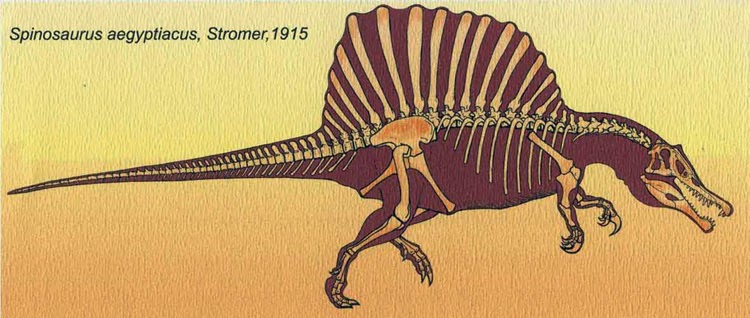

 My Spinosaurus aegyptiacus back-sail reconstruction from 2000-2001 and Stromer's original Spinosaurus skeleton reconstruction from 1915 (below):

Above are my revisions of Baryonyx walkeri skull and skeleton from Charig and Milner  

 Charig, A.J. and Milner, A.C. (1997). "Baryonyx walkeri, a fish-eating dinosaur from the Wealden of Surrey." Bulletin of the Natural History Museum of London, 53: 11–70.

***************

A few other images that have nothing to do with the above ones.

My classic, now a bit outdated, Phobosuchus/Deinosuchus croc restoration and and Allosaurus speculative embryo restoration (below)
My daughter pointing at the Cretaceous marine reptile Pontosaurus, exhibited at the CNHM in Zagreb (some 20 years ago!)


Tuesday, 12 August 2014

A little predator on a hunting spree

A short film I shot a few years ago.


Now imagine how a huge theropod like T. rex might have looked like while searching for its prey.


Here is my Torosaurus (mother with offspring) restoration from 2003.


I wonder if my illustration of Torosaurus chasing Paleosaniwa that has stolen one of it's eggs, is still on display at the Peabody Museum (Yale)? It has been 11 years since it was put as a part of the permanent exhibition. Time flies!


Monday, 11 August 2014

A possible dromaeosaur footprint

The Brijuni islands (Istria, Croatia) still need to be thoroughly researched for the dinosaur tracks. Here is a possible small Late Albian (Early Cretaceous) dromaeosaur footprint I have found on the Main Brijun island, a couple of years ago.


One of the dinoturbations on the Main Brijun island.


A sea gull chick on the Main Brijun island.


A sea gull's nest on the Main Brijun island. The modern dinosaurs (birds) nesting among the tracks of their distant ancestors and relatives (dinosaurs).


Wednesday, 6 August 2014

A puzzling feature in giant Early Cretaceous sauropod tracks in Pula

If you look carefully at the photographs I have shot on a Pula beach you'll probably notice  puzzling feature in giant Early Cretaceous sauropod tracks (Brontopodus). It appears that the footprints of the front feet (manus) were closer to the mid-line of the animal's body than the footprints of the hind feet (pes). The pes length impression is about 105 cm.

Is this the right manus/pes set? Notice the relatively small size of the typical crescent shape manus.The manus was preserved as an infilling (natural cast) while the pes is the true impression. In the image bellow both manus and pes were preserved as infillings (natural casts)

... and is this the left manus/pes set, or am I seeing it wrong and it's the opposite?
Anyway, if I am right, these tracks suggest that the giant Pula sauropod had very slender front limbs and very robust hind legs. The hips were much wider than the shoulders. The impressions of the front feet were often not or less preserved. The gait must have been somewhat similar to the gait of the modern giraffe, which also has a bit wider hips than shoulders so the impressions of the front feet are a tad closer to the mid body line than those of the hind feet.  The longest pes print of the Pula sauropod I have found and measured was about 130-140 cm. That was some truly huge titanosaur that must have measured at least 30-35 meters in length.
Here is a link for  Giraffe Walk


Tuesday, 5 August 2014

Traces of destruction at the Lovrecica track site

In this photograph the tracks of a medium-sized theropod from the Lovrecica Mid-Cretaceous track site are visible. The Istrian limestone (kirmenjak) is known for its toughness and durability. After all, many of the Istrian/Croatian and Italian towns used it extensively as building stone. Venice is the best known for its use.
Nevertheless, the damage left by the bulldozer driving over the outcrop is visible. It bruised the track's displacement rim (the white traces).
 The entire pieces of track bearing rock surface are missing now. The newspapers were sensationalistic in their reports claiming the tracks had been stolen. In my opinion it is a clear case of the negligence, ignorance and above all lack of protection implementation.


My interpretation is the red outline on the right. The bottom footprint is speculative.


A view at the sleepy Lovrecica, one early December morning in 2012.


The oak trees growing on the beach vis-à-vis Lovrecica.


Monday, 4 August 2014

Some tracks from the Main Brijun island


The trackways outcrop at the Pogledalo promontory of the Main Brijun island. Early Cretaceous of the ADCP (Adriatic-Dinaridic carbonate platform).


Some Barremian tracks from the Main Brijun island (the Pogledalo promontory), with my interpretation attempt.


Outlined in green is apparently a left foot impression of a large iguanodontoid. Bellow it in the photograph is a right footprint of the medium-sized theropod (red outline). There has been some skidding in the mud of both animals. The iguanodontoid track is partially (toe-hooves II and IV) a positive (cast). There is a track I couldn't figure out (this time) left of the iguanodontoid footprint.


Sunday, 3 August 2014

An ankylosaur trackway destroyed in Pula

I have just returned from a trip to Pula. It is sad, but a few of my photographs is the only thing that has remained of the first ankylosaur trackway in Pula, Croatia (the Adriatic-Dinaridic carbonate platform). I had discovered the tracks in 2011 and I didn't even manage to write the paper. The trackway, which was situated at one of the most frequented beaches in Pula has been covered with a thick layer of concrete for sunbathing. There are more tracks on that particular beach, but just one trackway that runs parallel to this one was preserved enough for research to be conducted. I fear that one is going to be destroyed as well in order to make the beach more comfortable for the numerous tourists. A few years ago I tried to warn the government institution State Institute for Nature Protection about the valuable, numerous trace fossils that are in the danger of being damaged or destroyed, but in vain. This isn't the first case of this kind either. Recently, the theropod trackways have been destroyed and damaged out of ignorance and negligence in Lovrecica, Istria, Croatia. News coverage of that event. That Lovrecica tracksite was even described in a scientific paper and should have been protected.
It is ironic, but I am probably the only person aware of this latest loss.
The "fossil of the fossil"- my photograph of irreversibly lost valuable piece of palaeontological natural heritage in Pula:

Latest news (August 2014): good ones (for now)!
Recently, I've visited this site and discovered that the concrete missed these two tracks (in the photo above) for about a meter. They are still there, but were covered with a muddy water. That's why I didn't see them during my previous visit.