Otok Veli Brijun (Brion) 2012. Mjerim veličinu otiska stopala velikog teropoda, koji je ostavio svoj oblik stopala (left pes) uključujući i metatarzalni dio, što je dosta rijetko.Iscrtao sam oblik crvenom linijom da se bolje vidi forma. Otisak vrha srednjeg prsta (#3) nedostaje.
Showing posts with label BDW. Show all posts
Monday, 13 May 2019
Main Brijun island tracks
Otok Veli Brijun (Brion) 2012. Mjerim veličinu otiska stopala velikog teropoda, koji je ostavio svoj oblik stopala (left pes) uključujući i metatarzalni dio, što je dosta rijetko.Iscrtao sam oblik crvenom linijom da se bolje vidi forma. Otisak vrha srednjeg prsta (#3) nedostaje.
Tuesday, 10 June 2014
Tempus fugit
Time flies. It even seems, that time is accelerating.
Here is some stuff from my old websites from the previous century... I think it was from the year 1997 until 2000.
Me and my late assistant Koki. Both of us got seriously ill soon after this photograph was taken. Koki died while I got another chance to live.
Pachycephalosaurus
Erlikosaurus
Xenosmilus
Suchomimus
and Homotherium
Monday, 10 February 2014
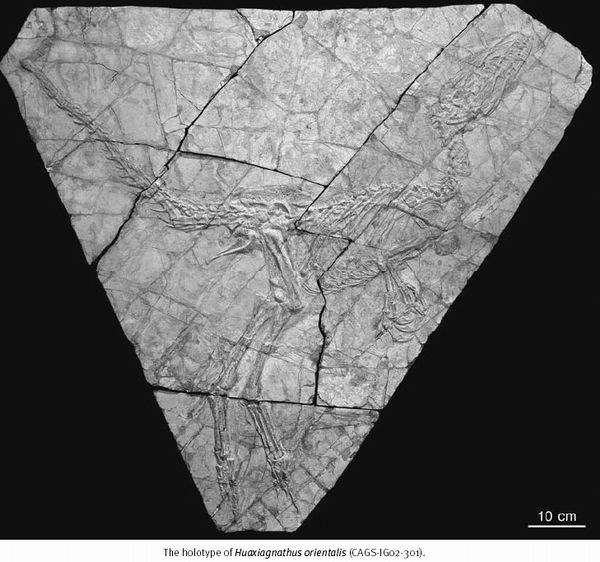
My old article from BDW on Huaxiagnathus
Huaxiagnathus orientalis - by Beri
Sunday, 9 February 2014
Repenomamus robustus - a large triconodont mammal from Early Cretaceous of China from BDW (2005)
| Mesozoic Mosaic pg #4 |
Illustration of a fierce Masozoic triconodont mammal , Repenomamus robustus chasing juvenile Psittacosaurus - by Beri (graphite), Copyright ©2005 BERI Jan 2005 |
MAMMALS STRIKE BACK Repenomamus robustus - a large triconodont mammal from Early Cretaceous of China HU, Y., J. MENG, Y. WANG & C. LI. 2005. Large Mesozoic mammals fed on young dinosaurs. Nature 433: 149-152. "Mesozoic mammals are commonly portrayed as shrew- or rat-sized animals that were mainly insectivorous, probably nocturnal and lived in the shadow of dinosaurs. The largest known Mesozoic mammal represented by substantially complete remains is Repenomamus robustus, a triconodont mammal from the Lower Cretaceous of Liaoning, China. An adult individual of R. robustus was the size of a Virginia opossum. Here we report a new species of the genus, represented by a skeleton with most of the skull and postcranium preserved in articulation. The new species is 50% larger than R. robustus in skull length. In addition, stomach contents associated with a skeleton of R. robustus reveal remains of a juvenile Psittacosaurus, a ceratopsian dinosaur. Our discoveries constitute the first direct evidence that some triconodont mammals were carnivorous and fed on small vertebrates, including young dinosaurs, and also show that Mesozoic mammals had a much greater range of body sizes than previously known. We suggest that Mesozoic mammals occupied diverse niches and that some large mammals probably competed with dinosaurs for food and territory." Abstract References: 1. Large Mesozoic mammals fed on young dinosaurs Yaoming Hu, Jin Meng, Yuanqing Wang, Chuankui Li SUMMARY: Mesozoic mammals are commonly portrayed as shrew- or rat-sized animals that were mainly insectivorous, probably nocturnal and lived in the shadow of dinosaurs. The... CONTEXT: ...Cretaceous Jehol Biota from the Yixian Formation in Liaoning, China, has yielded several mammal species. Two of them, Repenomamus robustus and Gobiconodon zofiae, are from the basal member of the formation that has a radiometric...... Nature433, 149 - 152 (13 Jan 2005) Letters to Nature Abstract | Full Text | PDF 2. Mammalian palaeobiology: Living large in the Cretaceous Anne Weil SUMMARY: Discoveries of large, carnivorous mammals from the Cretaceous challenge the long-held view that primitive mammals were small and not so interesting. Have palaeontologists been asking the wrong... CONTEXT: ...of questions and speculation among palaeontologists. The dinosaur-eater belongs to a species of large mammal, Repenomamus robustus, which was described first from a skull. The new specimen is more complete — and on its left side,...... Nature433, 116 - 117 (13 Jan 2005) News and Views Full Text | PDF 3. Mammal bites dinosaur Description: 13 January 2005 Mammal bites dinosaur We tend...... CONTEXT: ...picture is changing. The extinct mammal Repenomamus robustus, discovered five years ago, broke the mould: it was much bigger, the size of a Virginia opossum. And now another member of the genus Repenomamus has been found that is...... http://www.nature.com/nature/links/050113/050113-8.html *** Some comments: "Not to take anything away from the intrinsic coolness of this find, but the idea that Mesozoic mammals might have preyed on juvenile dinosaurs is hardly astonishing. Anybody familiar with the food habits of modern small mammals would have predicted it. In fact, I suggested just such a possibility way back in 1980 on pp. 70-71 of my contribution to _A Cold Look at the Warm-Blooded Dinosaurs_. What _IS_ surprising to me is just how big the bigger Mesozoic mammals seem to have gotten, at least in some faunas!" James Farlow, Ph.D. ***"...There are at least seven teeth on each jaw quadrant of the juvenile Psittacosaurus, of which most are worn. This demonstrates that the Psittacosaurus skeleton is not from an embryo (from the paper)...""Actually, late term vertebrates are notorious for grinding their teeth, whether in a womb or in an egg, Unhatched embryos of Hypacrosaurus from Canada show worn teeth." Ken Kenneth Carpenter, Ph.D. Repenomamus holotype A few notes on: Psittacosaurus sp. Age: Lower Cretaceous, Barremian Stage, Yixian Formation Place: Liaoning, China The psittacosaurids, known only from the late Early Cretaceous of Central Asia, are considered to be close to an ancestor of the horned dinosaurs. Both the parrot-beaked and horned dinosaurs possessed jaws, being curved and tapered forward and the lateral teeth highly specialised to masticate the vegetative food. Adult psittacosaurids were relatively small, up to 2 meters in length. They were probably mostly bipedal cursors although the forelimbs in these dinosaurs were relatively long and well-developed. |
Friday, 31 January 2014
Funny looking dinosaurs in vintage comics Part 1
When one stumbles upon dinosaurs in old comic books it's impossible not
to wonder how little did those authors know about the anatomy and life
styles of prehistoric animals. It is true, that in the 40's, until the 80's
little was known and published. However, still some excellent paleo
artists were around, like Zdenek Burian and Charles Knight, to name just the most prominent two.
A classic comic book theme: Time travelling to go to hunt dinosaurs and other prehistoric animals
Here is how Burne Hogarth depicts Tyrannosaurus (I presume that is what this is supposed to be).
Burne Hogarth (December 25, 1911 – January 28, 1996) was an American cartoonist, illustrator, educator, author and theoretician... (Wiki)
The anatomy is all wrong: the neck too long; the head a tad too small; the arms too long; one finger too many on each arm; looks bloated; legs weak and plantigrade (should be digtigrade like in birds); tail too short, too thin and too flexible...
...on the other hand his elephant is not exactly correct either...
... when I look at it better, even the lion has some strange features...
Don't get me wrong. I loved his final product: Tarzan comics.
Even in some more recent comics (from 90's) the dinosaurs are outdated. Pteranodon is not quite correct either.
Ankylosaur in the right lower corner is borrowed from Burian's Gorgosaurus vs. Scolosaurus painting. Pteranodon from another Burian's painting was also used as a reference. However, it is a pity, that these restorations were already outdated.
Saturday, 18 January 2014
Edmontosaurus with a fleshy rooster-like comb (repost)
Besides being a cartoonist I am also a paleoartist. I have been a paleoartist for decades. You can see some of my restorations at the Natural History Museum's in London site:
Natural History Museum London Picture Library
or at my old neglected Tripod site:
Beri's Dinosaur World (BDW)
I am happy to note that although many of the life restorations of dinosaurs and other prehistoric animals are decades old (the oldest dating from 1983), they still can pass as reasonably accurate ones or even don't have any major flaws regardless of the recent advances in paleontology and numerous new discoveries.
To cut the long story short, recently a new wonderful and very surprising Edmontosaurus fossil with some soft body parts impressions has been discovered and described. According to this find, not only the various dinosaurs had the bony combs, crests, horns and sails, but they might have been decorated with the fleshy ornaments as well. The Edmontosaurus had a fleshy rooster's comb.
National Geographic Society site has the story. Julius Csotonyi has produced a nice life restoration for the paper and the magazine.
Subscribe to:
Posts (Atom)