Showing posts with label Grakalovac. Show all posts

Thursday, 9 October 2014

Once again on Grakalovac

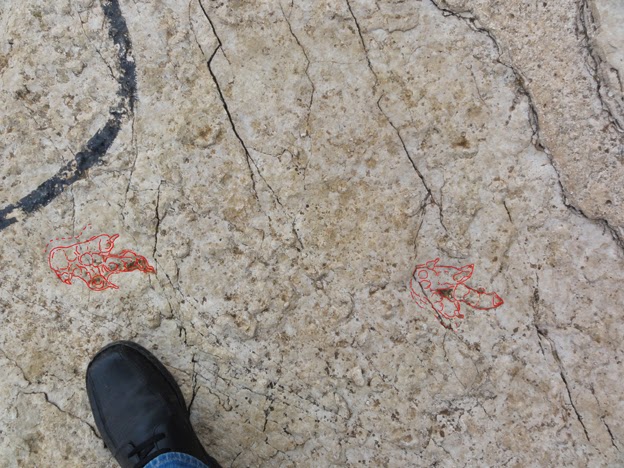
The Grakalovac promontory on the south Istrian Cape Kamenjak is famous for his medium sized theropod trackway from the late Cretaceous (Cenomanian). Every single footprint of this trackway is encircled by the (ugly) black paint. However, there are many more theropod tracks at the same outcrop, but they are less preserved and less visible. The image at the bottom shows the smaller footprints of a theropod that might have been related to the dromaeosauridae or noasauridae. The toe #2 seems to be reduced and baring a larger claw. But that is only an assumption. The dromaeosaurid tracks are extremely rare. This footprint is about 14,5 cm long.


I have done a bit different interpretation of this track before:

Back to Grakalovac (2)

It is a part of the trackway. However, in my first interpretation, which may be more detailed and better I didn't draw the surrounding poorly preserved prints. Which may be the prints that were placed a bit later, when the substrate was drier.


Beri's Dinosaur World

Monday, 25 August 2014

On Istrian tracks again

The footprint of a medium-sized theropod from the Grakalovac (Kamenjak/Premantura) site.


I keep finding new tracks after the heavy rains at the Ankylosaur dinoturbation site (I) in Pula. This left pes impression is about 40 cm long (+- 2 cm). my interpretation is the red outline below, of course. Obviously it belongs to the smaller specimen on the site. "Smaller" means that the dinosaur was probably about 8-9 meters long. That is huge for an ankylosaur! Now you can calculate yourself how big was the trackmaker anky who left the footprints some 70-75 cm long there!


The outcrop.


 ***************


Two consecutive cervical vertebrae of the Istrian pygmy titanosauriform sauropod (Early Cretaceous -Barremian). Only a small portion of the anterior one is preserved. The fossil before preparation. The photograph from the museum/gallery Ulika in Bale. — kraj: Bale-Valle Istra


Wednesday, 21 May 2014

Kamenjak ornithopod

There is an upper layer on the Grakalovac (Kamenjak #1) site, that has preserved tracks, too. I wonder why nobody has checked it out, yet. Just at a superficial glance I have spotted a nice, very small ornithopod footprint - in fact a natural cast, just about 12 cm long. I took a better look and there were a couple of poorly preserved tracks that formed a small trackway of apparently slowly walking dinosaur. See my photograph and interpretation outlines.

Whether this trackway was left by a juvenile or adult animal, nobody can tell. There are also some poorly preserved theropod tracks on that rock layer near by.


Tuesday, 13 May 2014

Grakalovac theropod tracks mystery (2)


Here is Fabio's (Dalla Vecchia et all, 2001) map of the Grakalovac (K1) site. In my opinion it is incomplete because the important (new?) tracks are omitted. The photograph below is turned upside down for coordinating the map's view point and the map's contents. "B" and "C" stand for the footprints and their track makers (see my diagram in the previous post). "S" stands for the undefined sauropod or/and ornithopod tracks.


In the mosaic photograph below are the tracks and the pace lengths of Grakalovac theropods arranged by size, growing from left to right. In this case, it seems the smaller the theropod, the relatively longer pace.


The next mosaic photograph are the closeups of some individual prints. "D" is mostly in-filled outline of the track. The track marked with "D" is outside the map area. "S" is apparently an oval shaped manus-pes set  of a very small sauropod. The pes has the drag marks behind it.


Although at the first sight the image in the first row below appears to be medium-sized, it is in fact just a partial print, missing a good deal of the heel. This prints is also outside the Fabio's map. In the right is the enlarged and superimposed red outline of the "C" print. It is revealing the true shape and size of this print (about 36-38 cm long).
The bottom row is the "D" print again with the interpretation on the right.


More to come in one of the posts to come: Are the peculiar tracks on Grakalovac, hadrosaur baby tracks or the prints left by a very small ornithopod ?


Monday, 12 May 2014

Grakalovac theropod tracks mystery (1)

 Kamenjak theropod lineup

When comparing my finds, photographs and measurements from Kamenjak 1 and 3 (I had discovered two more tracksites on Kamenjak, so I have named the sites K1, K2 and K3), with the data and conclusions from Fabio's (Dalla Vecchia et all, 2001) paper Dinosaur track sites in the upper Cenomanian (Late Cretaceous) of istrian peninsula (Croatia), describing the tracks from Grakalovac promontory (Kamenjak 1 or K1) something just doesn't add up. Many new questions and speculations appear. Here are some of my thoughts regarding this problem:
1. The theropod morphotype with a relatively very long  middle toe (#3) is reminiscent of an ancient theropod trait going all the way from the late Triassic and early Jurassic (Anchisauripus, Grallator, Brontozoum). Given that in general theropod feet are rather conservative and that they have not changed much over the 100 million year span, this can be plausible. I have already concluded that the tracks on Grakalovac were probably left by a ceratosaur or a compsognathid.
2. Dalla Vecchia has noticed and featured in his paper two size classes of theropod tracks on Grakalovac (K1), both being the same or very similar morphotype.  It seems that Fabio and his colleagues either didn't notice the other tracks, or more likely that the erosion has uncovered these new tracks during the past 14 years. I have noticed several new tracks, some of which were quite unusual. Among them are the ones that look like belonging to a baby hadrosaur.
3. It is a consensus that Istria and some other parts of ADCP was by the Cenomanian (Late Cretaceous) large island with the dwarf insular dinosaurs inhabiting it. That's where my large-foot theropods from K1 and especially K2 don't quite fit in. Or do they?
In the diagram below is the Kamenjak theropods lineup. The little brown silhouette is the Chinese "large compsognathid", with the foot about 11-12,5 cm long (A); marked with (B) is the small Grakalovac (K1) theropod from Fabio's paper and my photographs with a foot 16,5-17 cm long; (C) is the larger specimen from the paper (K1) and (D) is the largest track maker from K1 with the foot 38-40 cm long. The yellow silhouette (E) is the giant with the similar foot shape from the K3 track site, I had discovered last year. Its foot was around 65-67 cm long. 


3. So what is strange with this "insular" ichnocenosis is the obvious presence of very large theropods. I could settle with the 5-meters long one as one of a plausible size (D), but my discovery of the footprints which translate into a 8-10 meters huge beast (E) made me wonder: Am I seeing things? Are my interpretations wrong? Maybe the tracks were deformed? Maybe these were over sized under tracks? So far the evidence speaks in favour of true tracks.
4. Diminishing size or regression in growth of once large insular herbivores in order to compensate for the reduced food sources and maintain the viable population is a well documented biological scenario. So far, the evidence (tracks of herbivorous dinosaurs in Cenomanian rocks of Istria) speaks in favour of the pygmy island dwellers.Those were the small sauropods and small ornithopods.
How do the large theropods fit in here? Maybe they were oriented towards the sea based food? Fish eating dinosaurs? Like the spinosaurids. In any case, I do speculate that the small sauropods had to have some form of defence against the fierce giant predators. Maybe they were heavily armoured like the ankylosaurs? It is even possible that we still didn't find the tracks of the larger Cenomanian Istrian herbivorous dinosaurs.
One thing is certain: We will continue researching and learning new things about dinosaurs and their fantastic, mysterious world.


Friday, 9 May 2014

Back to Grakalovac (3)

It is a bit strange but the small theropod track morphotype fits the really ancient theropod foot bones. The one by the late Triassic Coelophysis. I speculate that these footprints were maybe left by a ceratosaurid or possibly by a compsognathid. The "large compsognathid from the early Cretaceous Yixian formation of China"  Huaxiagnathus is almost big enough to be a suspect. It's foot is only about 25% shorter than this Grakalovac (Kamenjak 1) diminutive theropod footprint. The proportions of the toes are quite similar. So our mini theropod might have been some close relative of this Chinese predatory dinosaur.


The articulated Huaxiagnathus feet in profile, from the paper.


Marvelous looking flat exposed rocks on the Grakalovac promontory. The view from a higher track baring outcrop. Some of these feature ripple marks and some of them still hide other tracks and traces.


Thursday, 8 May 2014

Back to Grakalovac (2)

To continue from the previous post, here is the second footprint (right pes) of the small theropod from the Grakalovac promontory...


... and here is the pace length (photograph below, with my red outline interpretation). Indicates a rather slow walk of a long-legged theropod:


Wednesday, 7 May 2014

Back to Grakalovac (1)

When tracks and traces are in question, best thing to do is to visit the sites more than once, preferably under different weather conditions, different time of day and different season. Especially in the case of poorly preserved and faint, barely visible tracks, the repeated visits will produce often surprising results. What's more important, the multiple observations will produce better results that are closer to the true. That said and after making new photographs, my Grakalovac (Kamenjak) giant thyreophoran is unlikely.
On this photograph taken from the official Kamenjak park site, the low sunshine implies multiple smaller prints instead of a single giant one. Yet, it is hard to determine their maker. They might be from a sauropod, like suggested in papers by Dalla Vecchia, Mezga and Bajraktarevic. Also, they might belong to a slowly moving ornithopod or a quadrupedal thyreophoran, or something entirely different. We'll probably never know for sure. The prints are rather inconsistent in shape and pace. The only thing that is certain about them is that they were made by a tetrapod. Maybe it wasn't just one animal, although, the grouping of the prints is suggesting that.


Here is my recent photograph of the "mysterious" Grakalovac prints, with my red outline interpretation/speculation. After analysing the photograph, this time it seems to me, there are a couple of small quadrupeds. Maybe the baby sauropods or really small pygmy sauropods whose tracks are mixed with the medium-sized ornithopod (green outline) who crossed this mini dinoturbation spot a bit later, when the substrate dried up a bit. But still the "ornithopod" slightly obliterated trackways left by the parallel walking "sauropods". The red arrow shows the direction of the tracks. Still, the tracks are so poorly preserved that my interpretation is highly speculative. You might have noticed that visually this mini dinoturbation suggested different direction of movement than my interpretation.


To my relief, I have found some theropod footprints close to this spot and there's no doubt about the trackmaker's foot shape and size. In the photograph below is one of the prints of the "cute" theropod with a foot 16,5 cm long (the animal was probably around 2 meters long).
The impression of the halux (toe #1) is clearly visible (forward oriented) as well as the claw prints on all the other toes.


Monday, 24 February 2014

Late Cenomanian theropod tracks


  Last year (2013) I finally visited the track site situated on an Istrian natural reserve park the cape "Kamenjak". There are Late Cretaceous (late Santonian) dinosaur tracks all over the place, but the best preserved are on the Grakalovac promontory, on the beach, near the entrance to the park.

A nice medium-sized theropod trackway is marked with ugly black circles (A). My interpretation (B). However, there are more theropod footprints scattered all around. See one in filled with the sediment (C) and my interpretation with a couple of more less preserved prints (D).
The larger tracks that nobody could identify so far, are also marked with black circle. They seem to me like the prints of a fairly large ankylosaur. More about it in the next post.


The Italian paleontologist Fabio Marco Dalla Vecchia wrote extensively on the dinosaur fossils in Istria. Here is one of the papers.