Showing posts with label dinosaur footprint. Show all posts

Monday, 6 October 2014

I have found the new dinosaur tracks again.

It seems that almost every visit I make to the Pula beaches must end with my discovery of the new mid-Cretaceous, Pula ichnofauna tracks. It happened again in September 2014.
Here is one of the outcrops with my interpretation of the probable theropod tracks. The foot length is about 30 cm.


One of Pula's outcrops.


Friday, 26 September 2014

Searching for tracks in Pula

A 100 million years old ripple marks on one of Pula beaches. I have seen the same pattern and size of ripples in the sand some 1,5 meters under the water while snorkeling.


A large (42 cm long) theropod footprint (Pula, Late Albian). It's situated at the "Ankylosaur dinoturbation" outcrop.


A small crocodilian trackway with some territorial scratch marks (on the right). Late Albian of Pula. Some sauropod, theropod and possibly pterosaur tracks are near by.


Thursday, 18 September 2014

Back to tracks

This is in fact the first iguanodontoid track I have discovered in Pula (above). My interpretation on the right (the red outline). Note the size compared to my big feet (# 46). It is Late Albian - Mid-Cretceous (about 100 mya). The same rock surface is dinoturbated mostly by large iguanodontoids and sauropods. Also, it is weathered, due to the vicinity of the open sea.

A bit smaller "Iggy" track I have discovered about a kilometre further down the beach (resort in Pula)

  A nice manus pes set track of a large pterosaur I have found on the same beach as the Iggy in the top photograph. There are three pterosaur trackways on that spot.

 A dinoturbated rock. Probably by the ankylosaurs whose trackways I have found near by. (Pula - Late Albian)


A small titanosaur left pes track. It was probably a subadult. The outcrop is heavily dinoturbated by the very large sauropods, theropods and ornithopods. Late Albian of Pula.


Thursday, 3 July 2014

Walking down the Cretaceous lane

A probable ankylosaur track (pes) from Pula. Outline of Sauropelta's pes (Carpenter) is on top of the footprint for matching.
In fact I am quite certain in my attribution, since it is not the only track of this shape and size there. With a bit of field work and mapping, the trackways could be identified. This was an animal of enormous size.

Strange traces in Pula. Possible theropod swimming traces?


A probable giant theropod track (natural cast) in Pula.


Another large theropod footprint from the Main Brijun island, that I couldn't figure out. A double impression, probably? Notice the giant "human" footprint on the left. I bet some enthusiastic creationist has put it there (hahaha)!


The so called (mini) "Pula fjord".


Trying the simple zoom on my pocket camera: A view at the Stoja and the steep Muzil cliffs near Pula. I haven't checked that place for tracks yet.


One of many Pula beaches. This track bearing one is my favourite spot for snorkeling.


The dusk pink clouds over Pula.


A poorly preserved giant theropod trackway in Pula.


Recent tracks and traces on a busy path through the meadow. Can you identify them?


Fake dinosaur tracks. Can you guess why am I so sure about it? 

Answer: This is Eocene flysch!


 A nice very large iguanodontoid footprint (Pula beach). I have found more tracks nearby that are almost perfect match to my red outline interpretation. These might have been subadults, because the largest ones I have found there are much bigger.


 A dusk over the Pula rocky beach. Dinosaur tracks became invisible and the swarms of mosquitoes irritating.


 What are the chances for these recent ripple marks to get preserved in this shape for 100 million years as a solid rock?


Wednesday, 2 July 2014

Wondering around and taking photographs

Some poorly preserved probable dinosaur tracks on a beach in Pula. Somebody has carved his (her?) initials in the rock (upper left corner), recently. I am almost certain a medium-sized iguanodontoid footprint is in front of my feet.


A 100 milion years old "flip-flop" impression. It seems like a No.46 or 47 compared to my own shoe.
It's a kind of track the creationists would probably die for.  However, it is probably a large fish bottom-feeding trace (possibly Acipenseridae). I have found many similar traces in Pula rocks.


The view at the Cape Stoja (Pula)


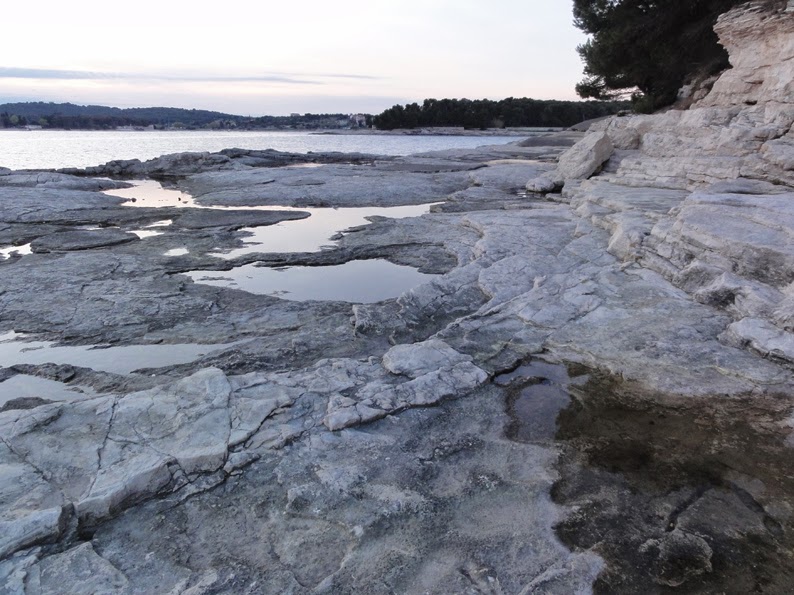
 Pula rocks.


 A nice amphitheatre carved in stone by the nature (Pula)


 The cliffs in Pula eroded by the strong waves.


 An interesting Pula outcrop that looks like a fresh mud, but it's a solid 100 million years old rock. It has traces of a strong current. Probably because of the fast receding tide. An unidentified dinosaur left its footprints in this ancient mud.


 I am always puzzled and frustrated when finding a track that I can't figure out. Here is a manus pes set from Pula. At first, I thought it might have belonged to a small ankylosaur. However, it has a certain resemblance to a crocodilian manus pes set. I am biased towards the ankylosaur provenance. On the other hand, the more I look at it, the more it looks like a crock's track to me. 


 A large, slender (?) theropod footprint with relatively long toe #3. It is a part of a rather poorly preserved trackway (Pula, late Albian).


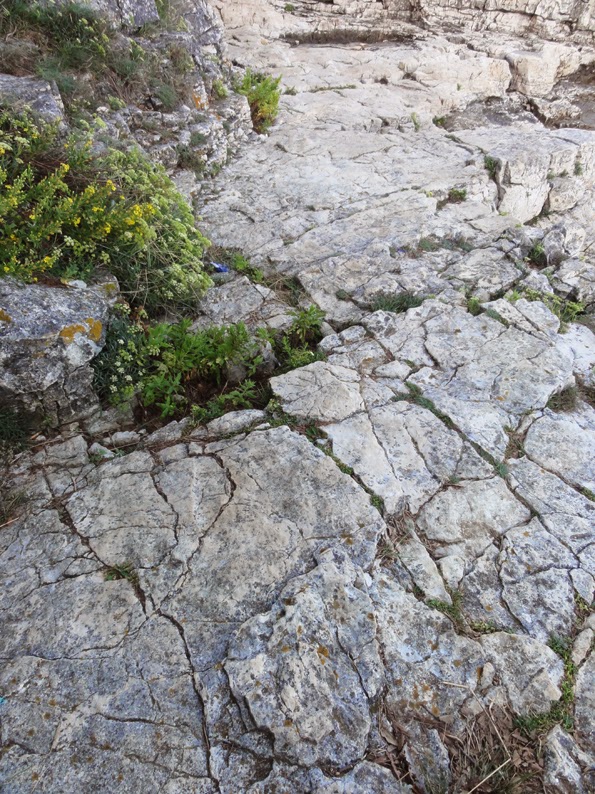
The early Cretaceous track bearing rocks in Pula.
 
 
 Of course, most of the old buildings in Istria were built from the Istrian limestone (kirmenjak). Some Italian cities like Venice, too. The sun clock on the Bembo-Soardo Palace in Bale.


Fossil track bearing rocks on Pula beach. A large theropod (?) footprint can be seen at the bottom centre of the picture.


 Fossil stromatolites on Pula beach.


Monday, 14 April 2014

A theropod or not

 Another example of a dubious footprint from late Albian rocks of Pula. I have interpreted it as a tridactyl track. It's probably a theropod. But I am not sure. It may be an ornithopod and even a thyreophoran. There's a short trackway there on that rock that may be thyreophoran and I have attributed one footprint to an iguanodontoid. There's even a chance that all those tracks of relatively small size belonged to the same animal. Making a detailed sketch of the outcrop and taking some casts would probably resolve the dilemmas.

 A small modern "theropod" was watching me taking the photographs.