Showing posts with label Mesozoic. Show all posts

Monday, 10 June 2024

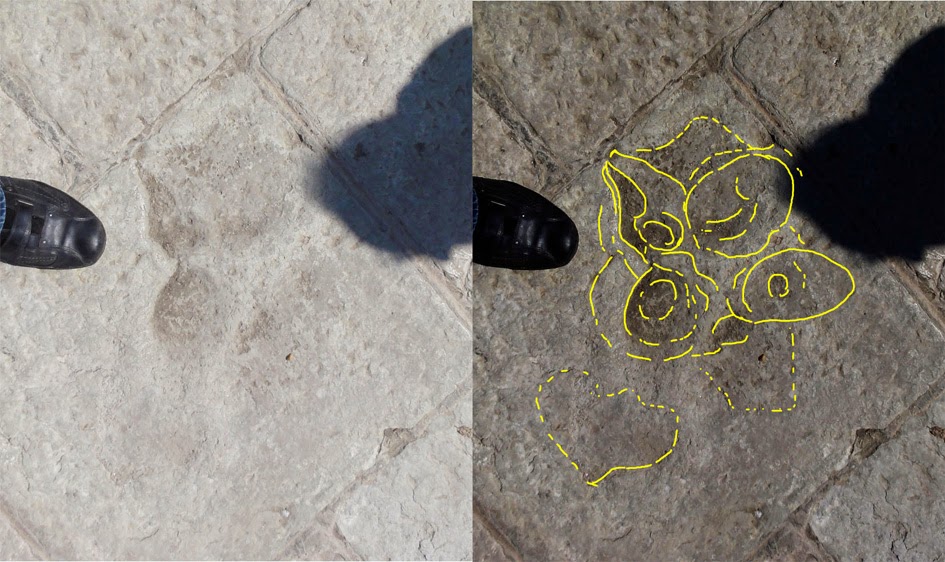
Another strange body impression


The Pula mega track site

A peculiar case of the probable reptilian body print from EK mega track site in Pula. Candidates: croc, gator, monitor lizard, chamsposaurid. Seemingly very large oval scales on the belly. It appears it had 5 toes on legs - (croc has 4)

The photo of the impression in situ and my interpretation:


Some ref literature


27 April 2022


CITING LITERATURE

  • The ichnology of shallow-marine and transitional environments, Geological Society, London, Special Publications, 10.1144/SP522-2022-344, 5221, (1-4), (2023).
  • Defining the Bemaraha megatracksite: an update on dinosaur ichnology in Madagascar, Geological Society, London, Special Publications, 10.1144/SP522-2021-86, 5221, (2022).
  • Dinosaur tracks in a Cretaceous (lower Albian) braid delta system (Basque–Cantabrian Basin, western Pyrenees): linking trace fossils suites and short-term preservation windows, Geological Society, London, Special Publications, 10.1144/SP522-2021-197, 5221, (237-264), (2022).

Wednesday, 25 October 2017

Friday, 30 May 2014

A quiz question: Who left this track?(2)

Guess the tetrapod from the track!
 ... and the answer is: a large iguanodontoid


 In the image above:
1) Iguanodontian track from the Main Brijun island. Probably left pes footprint. Note my feet size #46 at the bottom of the photograph.
2) A close up of the hoof (ungual) #3. Note the similarities of the print (cast) with the Romanian true ungual fossils (Fig.4). Note that the base, or the distal part of the ungual also left an impression. In fact, I have discovered that a rather well defined toe impression of an iguanodontoid track maker often preserves and thus could be considered a diagnostic feature.
3) My interpretation of the footprint - red outline.
4) Iguanodontian ungual #3 from Romania, Early Cretaceous (left-bottom; right-top of the hoof), from this paper:

 IGUANODONTIAN DINOSAURS FROM THE
LOWER CRETACEOUS BAUXITE SITE FROM ROMANIA
ERIKA POSMOŞANU
ACTA PALAEONTOLOGICA ROMANIAE V. 4 (2003), P. 431-439


As for the results of the Quiz. There's no winner. Nobody even tried guessing. So, am I just imagining things?


Thursday, 22 May 2014

The iguanodontoid tracks from the Main Brijun island

You can download a free PDF of the official brochure for the dinosaur tracks of the Brijuni islands
(... in the production of which I wasn't involved): Promenade of dinosaurs .

In the photograph below is presumably one of the iguanodontoid (left pes) footprints on the peer of the Main Brijun harbour. The yellow outline is my interpretation. Track is about 32 cm long. Note the pointed toe #4 impression.

The probable, very shallow iguanodontoid tracks in my photographs are from the Pogledalo promontory of the Main Brijun island. My interpretative drawings are on the right. I have placed my interpretation in red outline from the bottom picture, over the yellow outline in the upper image for comparison. It seems there's a manus impression between the toes #3 and #4 of the right pes. Note the pointed toe #4 impression, just like in the footprint on the peer.The footprint is about 55 cm long.
The iguanodontoids and sauropods would present a perfect prey for the large theropods that left their footprints on the same promontory.


Saturday, 17 May 2014

A quiz question: Who left this track?

Guess the tetrapod from the track!

The Cape Pogledalo, Main Brijun island (V. Brijun) site.
  
To tell you the truth, at first, while looking at it in situ, I miss interpreted the impression in the photograph below. Only back at home when analysing the photograph on my PC, I have concluded I had been totally wrong in my attribution. It is not a typical footprint example for the particular ichno family. So, this task is really a tough one! A specific diagnostic feature made me change my initial speculation. After that I spotted the other characteristic features, that were not that obvious at the site but which confirmed my thoughts. Although, this diagnostic feature is not always present in the footprints of these dinosaurs, it helped me resolve my dilemma quite a few times.


I'll give you a couple of hints: The site is the Cape Pogledalo on the Main Brijun island (Istria, Croatia), of the Barremian age (early Cretaceous), described in the paper by Dalla Vecchia ; this print was not described in his paper. Note the tip of my shoe (#46) on the right for size. When watched from the side, the track looks like a large shallow bowl. By the icnology standards the footprint is poorly preserved (except one crucial detail).
I challenge the ichnologists to give the answer and the clues in the comments. What kind of animal left this print? 
 Of course, after some time I'll reveal my interpretation and the  diagnostic hot spots.

The usual suspects are: A) theropod, B) sauropod, C) stegosaur, D) ankylosaur, E) iguanodontoid, F) croc, G) pterosaur, H) turtle, I) lizard, J) bird, K) mammal, L) fish
Please, select one of the answers and post it via Comments below:


Friday, 7 March 2014

Dinosaur news: The Largest Terrestrial Predator from Europe


In the New PLoS ONE journal, Christophe Hendrickx & Octávio Mateus published the discovery of a giant European theropod (the fossil maxilla) from the Lourinhã Formation (Kimmeridgian-Tithonian) of Central West Portugal. The Formation " is well known for its diversified dinosaur fauna similar to that of the Morrison Formation of North America; both areas share dinosaur taxa including the top predator Torvosaurus, reported in Portugal."

Here is my (really quick) sketch of how the dinosaur may looked like in life:


Of course, Triceratops in my logo is not here for the scale :-) 

Free paper: Torvosaurus gurneyi n. sp., the Largest Terrestrial Predator from Europe, and a Proposed Terminology of the Maxilla Anatomy in Nonavian Theropods


Wednesday, 5 March 2014

A Quaternary digression


contact.html

A  skeleton of a small Quaternary horse in a breccia in the midst of the Cretaceous rocks

It is interesting that many Cretaceous limestone sediments have gaps which are filled in by the Quaternary breccia, often containing jumbled bones. Thus the name: the bone breccias. Here is one from the Pula "dinosaur track sites" containing the bones of a small horse (photo credit: B.Krzic):


 The close up: Outlined with red are front legs hooves (heart shape) and the skull.


The age of these "breccia horses" of the genus Equus is late Villafranchian to ? Holsteinian (possibly even late Pleistocene).
 
A paper:

Paläontologische Zeitschrift
December 1992, Volume 66, Issue 3-4, pp 369-385
Mirko Malez, Ann Forsten,Jadranka Lenardic

Wednesday, 22 January 2014

Nyctosaurus - a pterosaur with a large crest (BDW repost)


This is a repost from my "extinct" Geocities site.

Illustration of Nyctosaurus KJ2 flying - by Beri (digital), Copyright © 2004 BERI


Christopher Bennett from University of Bridgeport Bridgeport, CT, described a couple of exciting fossil specimens of pterosaurs: Nyctosaurus - a pterosaur with a large crest
Bennett S. C. 2003. New crested specimens of the Late Cretaceous pterosaur Nyctosaurus. - Palaeontologische Zeitschrift, 77 (1): 61-75, 6 figs., 1 tab.; Stuttgart.


Nyctosaurus turned out to have an extremely large cranial crest nearly three times the length of the skull and bifurcating into an upward extending and a shorter backward extending ramus. Whether these supported a sail-like membrane is at the moment a pure speculation. As Chris notes: "I discussed the question of a membrane between the two rami of the crest in the paper and concluded that there was no evidence of any membrane between the rami and good reason to think that there was not one. Despite that, for some reason that I cannot understand everyone else seems to think that there was a membrane between the rami." Evidence is based on 2 specimens in a private collection. No species name is applied and the specimens are refereed to as KJ1&KJ2.