25 years ago, I wrote and illustrated an article on spinosaurs for a Japanese dinosaur magazine. I corrected my reconstruction by making a new tail.
Showing posts with label dinosaur. Show all posts
Saturday, 3 January 2026
Sunday, 19 May 2019
Thursday, 16 May 2019
Moj ranokredni mural
„IZGUBLJENI SVJETOVI ‒ pradavni vrtovi devona, karbona i krede“: znanstveno-popularna izložba u Botaničkom vrtu Prirodoslovno-matematičkog fakulteta Sveučilišta u Zagrebu, 2018.- Vidjelo ju je preko 20.000 ljudi. Tko još nije bio ima ponovno priliku jer je postavljena i ove godine.
Ulaz je slobodan.
Moj mural, koji je dio izložbe, jutros na nacionalnoj HRT
Monday, 13 May 2019
Main Brijun island tracks
Otok Veli Brijun (Brion) 2012. Mjerim veličinu otiska stopala velikog teropoda, koji je ostavio svoj oblik stopala (left pes) uključujući i metatarzalni dio, što je dosta rijetko.Iscrtao sam oblik crvenom linijom da se bolje vidi forma. Otisak vrha srednjeg prsta (#3) nedostaje.
Wednesday, 25 October 2017
Friday, 20 June 2014
A couple of different photographs
One of the photographs I took a couple of years ago, showing dwarf sauropod and theropod tracks at the Solaris (fkk auto camp) Early Cretaceous (Late Albian) outcrop.
For a change of pace: Here is a photograph of the Oligocene plant fossils I have collected near Zagorje ob Savi (Slovenia) many years ago. A toxodium branch (left) and a laurel leaf (right). The area was obviously a cypress swamp.
Friday, 30 May 2014
A quiz question: Who left this track?(2)
Guess the tetrapod from the track!
... and the answer is: a large iguanodontoid
In the image above:
1) Iguanodontian track from the Main Brijun island. Probably left pes footprint. Note my feet size #46 at the bottom of the photograph.
2) A close up of the hoof (ungual) #3. Note the similarities of the print (cast) with the Romanian true ungual fossils (Fig.4). Note that the base, or the distal part of the ungual also left an impression. In fact, I have discovered that a rather well defined toe impression of an iguanodontoid track maker often preserves and thus could be considered a diagnostic feature.
3) My interpretation of the footprint - red outline.
4) Iguanodontian ungual #3 from Romania, Early Cretaceous (left-bottom; right-top of the hoof), from this paper:
IGUANODONTIAN DINOSAURS FROM THE
LOWER CRETACEOUS BAUXITE SITE FROM ROMANIA
ERIKA POSMOŞANU
ACTA PALAEONTOLOGICA ROMANIAE V. 4 (2003), P. 431-439
As for the results of the Quiz. There's no winner. Nobody even tried guessing. So, am I just imagining things?
... and the answer is: a large iguanodontoid
In the image above:
1) Iguanodontian track from the Main Brijun island. Probably left pes footprint. Note my feet size #46 at the bottom of the photograph.
2) A close up of the hoof (ungual) #3. Note the similarities of the print (cast) with the Romanian true ungual fossils (Fig.4). Note that the base, or the distal part of the ungual also left an impression. In fact, I have discovered that a rather well defined toe impression of an iguanodontoid track maker often preserves and thus could be considered a diagnostic feature.
3) My interpretation of the footprint - red outline.
4) Iguanodontian ungual #3 from Romania, Early Cretaceous (left-bottom; right-top of the hoof), from this paper:
IGUANODONTIAN DINOSAURS FROM THE
LOWER CRETACEOUS BAUXITE SITE FROM ROMANIA
ERIKA POSMOŞANU
ACTA PALAEONTOLOGICA ROMANIAE V. 4 (2003), P. 431-439
As for the results of the Quiz. There's no winner. Nobody even tried guessing. So, am I just imagining things?
Thursday, 22 May 2014
The iguanodontoid tracks from the Main Brijun island
You can download a free PDF of the official brochure for the dinosaur tracks of the Brijuni islands
(... in the production of which I wasn't involved): Promenade of dinosaurs .
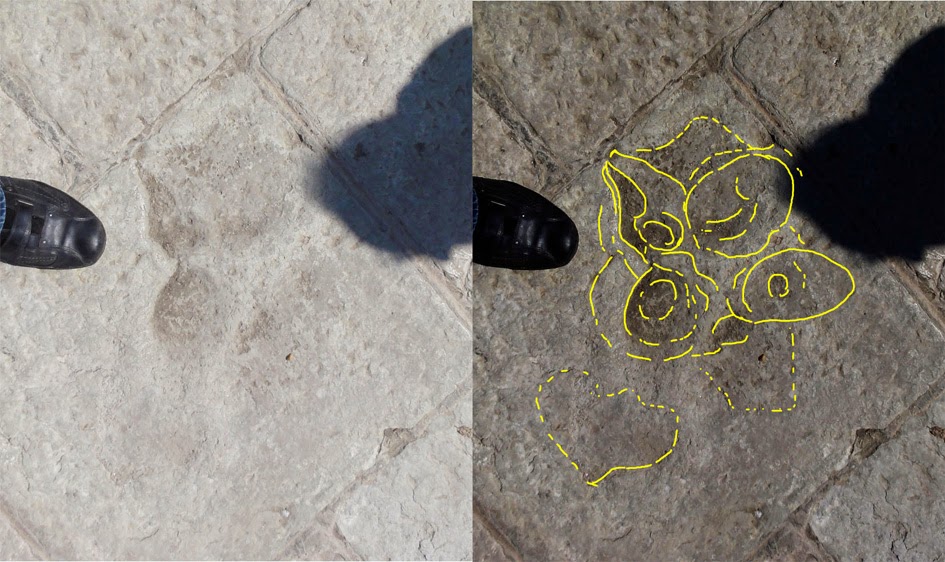
In the photograph below is presumably one of the iguanodontoid (left pes) footprints on the peer of the Main Brijun harbour. The yellow outline is my interpretation. Track is about 32 cm long. Note the pointed toe #4 impression.
(... in the production of which I wasn't involved): Promenade of dinosaurs .
In the photograph below is presumably one of the iguanodontoid (left pes) footprints on the peer of the Main Brijun harbour. The yellow outline is my interpretation. Track is about 32 cm long. Note the pointed toe #4 impression.
The probable, very shallow iguanodontoid tracks in my photographs are from the Pogledalo promontory of the Main Brijun island. My interpretative drawings are on the right. I have placed my interpretation in red outline from the bottom picture, over the yellow outline in the upper image for comparison. It seems there's a manus impression between the toes #3 and #4 of the right pes. Note the pointed toe #4 impression, just like in the footprint on the peer.The footprint is about 55 cm long.
The iguanodontoids and sauropods would present a perfect prey for the large theropods that left their footprints on the same promontory.
Saturday, 17 May 2014
A quiz question: Who left this track?
Guess the tetrapod from the track!
The Cape Pogledalo, Main Brijun island (V. Brijun) site.
To tell you the truth, at first, while looking at it in situ, I miss interpreted the impression in the photograph below. Only back at home when analysing the photograph on my PC, I have concluded I had been totally wrong in my attribution. It is not a typical footprint example for the particular ichno family. So, this task is really a tough one! A specific diagnostic feature made me change my initial speculation. After that I spotted the other characteristic features, that were not that obvious at the site but which confirmed my thoughts. Although, this diagnostic feature is not always present in the footprints of these dinosaurs, it helped me resolve my dilemma quite a few times.
I'll give you a couple of hints: The site is the Cape Pogledalo on the Main Brijun island (Istria, Croatia), of the Barremian age (early Cretaceous), described in the paper by Dalla Vecchia ; this print was not described in his paper. Note the tip of my shoe (#46) on the right for size. When watched from the side, the track looks like a large shallow bowl. By the icnology standards the footprint is poorly preserved (except one crucial detail).
I challenge the ichnologists to give the answer and the clues in the comments. What kind of animal left this print?
Of course, after some time I'll reveal my interpretation and the diagnostic hot spots.
The usual suspects are: A) theropod, B) sauropod, C) stegosaur, D) ankylosaur, E) iguanodontoid, F) croc, G) pterosaur, H) turtle, I) lizard, J) bird, K) mammal, L) fish
Please, select one of the answers and post it via Comments below:
Friday, 21 March 2014
My old view at the good old T.rex
Here is my quarter of a century old Tyrannosaurus rex painting. If you look at it carefully, you'll notice the "fleshy" lizard-like lips on the beloved theropod. Given an even a closer look at the painting, you'll notice a few water birds in the background. The birds caused sort of a commotion among the visitors, who thought they were educated in the issue, at the opening of the exhibition of my prehistoric animals paintings at the Croatian Natural History Museum in Zagreb in 1994. Most people knew only about the Archaeopteryx as the sole Mesozoic bird at the time, so my intentional provocation with the duck-like birds hit the chord. I know that this sounds like a joke today, but the greatest bird (and dinosaur) discoveries were yet to come.
Also notice the legs are not in a (popular) squatting position, but more errect, which does make sense for the animal of that size.
The painting was produced in gouache in 1988 and it has been in the collection of the CNHM in Zagreb since 1991.
Tuesday, 18 March 2014
A theropod track from Pula
Here is an interesting shape of the large theropod footprint from Pula (Albian - early Cretaceous), I have found recently. At the first sight it looks like some giant bird's track. In fact it is the collapsed mud/sand impression that was probably partially washed away by the tide (the outcrop features the long low crested ripple marks). The possible second footprint is only barely visible in front and a bit to the right from the first one in the photograph. The length of the track is about 46 cm. The animal was probably some 6 to 6,5 meters long.
The same outcrop has preserved the small theropod prints; the giant pterosaur manus prints; small and medium sized pterosaur footprints; medium-sized sauropod tracks and huge iguanodontoid footprints.
Sunday, 2 March 2014
Histriasaurus: the basal rebbachisaurid from Istria
The dinosaur bone bed near Bale
There are only three dinosaur species (two genera) from Croatia, that were properly described and named. Both of the new genera holotypes were determined and named by the Italian paleontologist Fabio Marco Dalla Vecchia. While one of them is an ichnospecies, Titanosaurimanus nana (Dalla Vecchia & Tarlao, 2000), based solely on its tracks, the other one is based on the fossil bones. It was a mid-sized rebbachisaurid Histriasaurus boscarollii (Dalla Vecchia, 1998)
Rebbachisauridae was a family of sauropod dinosaurs known from fragmentary fossil remains from the Cretaceous of South America, Africa, and Europe.
In the photo is the small museum Ulika in an old town Bale, in Istria, Croatia, where the holotype of Histriasaurus and the rest of the Croatian dinosaur fossils are housed. The dinosaur fossil site is just a couple of kilometres away. The dinosaur undersea graveyard is still a sort of terra incognita, because there was no funding for extensive excavation and research. Matt Lamanna told me there were attempts of getting funded form the National Geographic, but so far unsuccessful. Hopefully, the research in Bale will resume, soon.
A few rebbachisaurid dorsal vertebrae comparison (not exactly to scale): the Spanish Demandasaurus darwini (Fernández-Baldor et al.), 2011 - photo ©Fidel Torcida, the fossil housed at EL Museo de Dinosaurios de Salas de los Infantes (A), the African Rebbachisaurus garasbae (Lavocat, 1954) - photo by ©Muséum National d’Histoire Natural where the fossil is housed (B), the Croatian Histriasaurus boscarollii (Dalla Vecchia, 1998) - photo by B. Krzic (C).
An article on new Spanish rebbachisaurid.
My old Histriasaurus boscarollii restoration (from 2003?):
It is interesting noting that the only Croatian dinosaurs with names were never given a scientific and public attention they have deserved. There was no sculptural restoration, no postal stamp, no dedicated book. One feeble attempt to mark the presence of dinosaur fossil bones in Croatia was made by issuing a postal stamp . An iguanodontoid was featured in the image.
The recent Ulika museum is the first to give them the credit. Pity that the museum is still relatively unknown, although, it has been open for public almost a year ago.
Thursday, 20 February 2014
A sauropod right pes on a building block
A sauropod right pes on a building block of the Early Cretaceous limestone at the pier near Pula (Istria, Croatia)
I don't remember if I said it before, but Istria has been literary "littered" with the Mesozoic fossils. The dinosaur tracks can be considered as numerous and omnipresent. Which doesn't mean they are easy to find by laymen. One has to learn distinguishing them from common artifacts. The limestone erosion is prone to forming very rich array of shapes.
So, here I am, walking along the beach and looking for some familiar shapes. I get awarded quite often. Here is a nice sauropod (probably a titanosaur) right hind foot print on a building block. The production process in the quarry left it in a rather good shape. Although, the block looks slightly "flawed" because of the dinosaur impression. The photograph was taken on February 15th 2014. Red outline helps you visualise the print. There is a low displacement rim in front of the track, where it should be. The pes measures about 60 cm in length, representing a decent size track maker sauropod. The largest sauropod hind footprints I've found there measure about 130-140 cm in length. Those were true giants!
Finding dinosaur tracks on building blocks is not that rare either. I've found many myself. Some of the tracks were found by Dalla Vecchia, as described in his paper.
Tuesday, 11 February 2014
Nodosaur and possibly Rhabdodon finds in Quarry Stranice near Slovenske Konjice (repost from BDW 2005)
Mesozoic
Mosaic pg #5
| Mesozoic Mosaic pg #5 | |||
Photograph of Struthiosaurus austriacus (Bunzel 1870) fossil on display in Natural History Museum in Vienna Site: Muthmannsdorf near Wiener Neustadt, Austria Struthiosaurus might look like a cross between Edmontonia and Sauropelta, says Kenneth Carpenter, Ph.D. Struthiosaurus References s: (update 2014) |
|||
Nodosaur and possibly Rhabdodon finds in Quarry Stranice near Slovenske Konjice In the sediments of Quarry Stranice (kamnoloma Stranice) near SlovenskeKonjice (Campanian; gosauski razvoj) in north-east Slovenia, fossils of single and colonial corals were found. In addition to the corals, bivalves, fragments of sponges, snail shells, ostracodes, briozoa, algae and foraminifera were also found. On the west side of the site, near Lipa, fragments of fish teeth, a crocodylian tooth and the long bones of dinosaurs were discovered. These fossils were first found in 1999 by Franc Pajtler, and researched by Dr. Irena Debeljak. Dr. Debeljak (ZRC SAZU) thought the bones possibly belonged to a medium-sized quadrupedal plant-eating nodosaur, which was a member of the family Ankylosauria. This is the second discovery of dinosaurs in Slovenia. The first one, near Kozina, was in an area that was separated from Quarry Stranice in the Upper Cretaceous by the sea, precluding a comparison of the fauna from the two sites. The fossils of dinosaurs, crocodylians, turtles and freshwater fish indicate a rich vertebrate fauna at that time. The nearest site to Stranice with nodosaur remains is in the vicinity of Vienna (Muthmannsdorf -Wienerneustadt, Avstria). The locality of Quarry Stranice (kamnoloma Stranice) near Slovenske Konjice thus becomes an important palaeontological find. The fossils are on display in the Natural History Museum in Ljubljana: http://www2.pms-lj.si/oddelki/paleontologija/stranice.html English translation: Berislav Krzic Edited by: Brian Franczak Note (Feb/2014): as to my knowledge, up to this day, no further research has been conducted regarding the Quarry Stranice fossil finds. . |
Subscribe to:
Posts (Atom)