Showing posts with label A Mesozoic Mosaic. Show all posts

Friday, 31 January 2014

Funny looking dinosaurs in vintage comics Part 1


When one stumbles upon dinosaurs in old comic books it's impossible not to wonder how little did those authors know about the anatomy and life styles of prehistoric animals. It is true, that in the 40's, until the 80's little was known and published. However, still some excellent paleo artists were around, like Zdenek Burian and Charles Knight, to name just the most prominent two.

A classic comic book theme: Time travelling to go to hunt dinosaurs and other prehistoric animals


Here is how  Burne Hogarth depicts Tyrannosaurus (I presume that is what this is supposed to be).
 Burne Hogarth (December 25, 1911 – January 28, 1996) was an American cartoonist, illustrator, educator, author and theoretician... (Wiki)
The anatomy is all wrong: the neck too long; the head a tad too small; the arms too long; one finger too many on each arm; looks bloated; legs weak and plantigrade (should be digtigrade like in birds); tail too short, too thin and too flexible...


...on the other hand his elephant is not exactly correct either...


... when I look at it better, even the lion has some strange features...


 Don't get me wrong. I loved his final product: Tarzan comics.

Even in some more recent comics (from 90's) the dinosaurs are outdated. Pteranodon is not quite correct either.

Nathan Never is a black-and-white, science fiction Italian comic book, published monthly in Italy since 1991 by Sergio Bonelli Editore (Wiki)
Ankylosaur in the right lower corner is borrowed from Burian's Gorgosaurus vs. Scolosaurus painting. Pteranodon from another Burian's painting was also used as a reference. However, it is a pity, that these restorations were already outdated.


Sunday, 19 January 2014

Forbidden planet's Monster from the ID part 2


Flying saucer's Commander and the medical Doctor examine the cast of the monster's footprint. Their discussion:

DR.: -  NO, NO, CAPTAIN, THIS CREATURE RUNS COUNTER TO EVERY KNOWN LAW OF ADAPTIVE EVOLUTION.
COMMANDER (L. Nielsen): - WHAT DO YOU MEAN?
DR.: - NOTICE THIS STRUCTURE HERE? CHARACTERISTIC OF A FOUR-FOOTED ANIMAL. YET, OUR VISITOR OF TONIGHT LEFT THE FOOTPRINTS OF A BIPED. PRIMARILY A GROUND ANIMAL, TOO. IF THIS CLAW CAN ONLY BELONG TO AN ARBOREAL CREATURE, LIKE SOME IMPOSSIBLE TREE SLOTH. JUST DOESN'T FIT INTO A NORMAL NATURE.

BDW (Beri's Dinosaur World): - And yet, the good old doctor was quite wrong in his assumptions regarding the nature of the tracker as well as the nature of the the other real creatures that lived or are living on Earth.
First of all there's no way a footprint would have been preserved in such a detail to enable making a plaster cast of the quality featured in the movie. Second, the depth of the footprint is more related to the substrate material and its consistency than to the size or the weight of the animal. I have seen very deep fossil tracks left by the small dinosaurs and very shallow left by the giant ones. Even if the ID was walking on an ideally prepared clay, taking the foot out of it would deform the footprint's impression.
fact is that the arboreal living sloths have claws much different than the claw on the foot of the ID monster. In fact the sloth claws resemble the claws of a giant dinosaur Therizinosaurus. Here is the left arm of the three-toed sloth (Bradypus). The three-toed sloth's long claws are are adapted to an arboreal life but restrain its mobility on the ground.

Right hand and right foot (with a bit shorter claws) of Bradypus:


 The left foot of the extinct giant ground sloth mounted in NHM in London. (Photo credit: B.Krzic)
It looks as if from a biped, but ground sloths were primarily quadrupeds.


Left hand of Bradypus


Note the similarity of the tree sloths hand claws with the long, laterally flattened, slightly curved claws on the right hand (manus) of the giant dinosaur Therizinosaurus:


Source: Wikipedia

Dromaeosaurid killing sickle-claw was also compressed laterally. Here is the right foot of Deinonychus armed with the curved claw on toe #2:


In fact the ID's foot can be defined as a titanosaur sauropod foot armed with the allosaurid finger #1 claw.

Doctor in the movie measured the footprint cats of the monster:  37 INCHES BY 19 (about 90 cm long), quite shy compared to the Early Cretaceous sauropod footprints I have found in Istria: 130 cm long! ID's height = 460 cm.

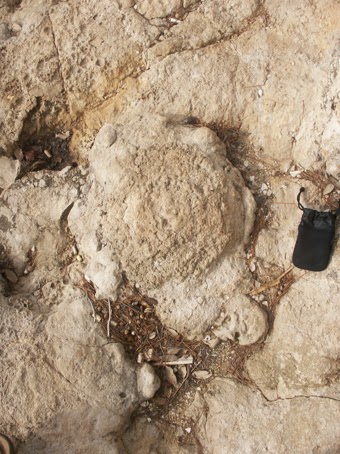
Here is a rather good, but not quite complete (part of the heel is missing) natural cast of the right foot of the small sauropod (a titanosaur?).  You can see the little knobs, impressions of the toes. For size comparison: the little black bag is 13 cm long.


Here is the left footprint cast (130 cm long) of the giant sauropod from the same site. It is almost complete, but the impressions of the toe claws didn't preserve (photo credit: Berislav Krzic)


The ID's footprint cast of the right foot from the movie (below). A peculiar resemblance to the true sauropod track in the photo above (photo credit: Berislav Krzic)


 My restoration of the suropod's left foot based on the positive foot impression:


It is interesting to note that some quadruped dinosaurs were facultative bipeds. It's not just that they were capable of rearing up on their hind limbs, like the modern elephants can do, but it seems some were capable of walking or even running in both modes. Here is a paper on one such find:Tracks of a Running Bipedal Baby Brontosaur? Baby Sauropod Footprints Discovered in Colorado - Science Daily
Trivia for the end of this post:

The (animated) "big as a house", invisible, indestructible biped monster of ID in a shimmering light from blasters' fire in a climax scene in the movie.


Here is the best model of the ID monster I've seen: Forbidden Planet's ID Monster
 It is still not the real thing in my opinion. So, you'd better check out my restoration in the 3rd instalment of this article.


Friday, 17 January 2014

Forbidden planet's Monster from the ID part 1 (repost)


  I have reposted my paleontology related stuff published previously on my Oberon cartoons blog:

I keep watching Forbidden planet movie (1956) from time to time. It was so good, so ahead of its time in so many ways: from the music score to the design. One of my favourite scenes is when the captain and the doctor were speculating about the shape of the monster, deducting from cast of its footprint. It is quite similar to the real task when paleontologists are trying to figure out the characteristics and features of extinct animals who left only their petrified tracks in the rock. I search for the ancient tracks on the Adriatic coast and it is a lot of research and fun.


It is also amusing that some species of dinosaurs had claws, not unlike the one from the movie, but on their three-fingered hands. Check out the cast of the finger claw of the allosaurid theropod  Saurophaganax here :
 Sauropod Vertebra Picture of the Week

My drawings of the fossil bones of some theropod hands. Above is Megaraptor left hand (manus) and below is Allosaurus left hand:


Thursday, 16 January 2014

A dinosaur oriented blog


After a couple of weeks of posting on my first (experimental in a way) blog "Oberon Cartoons", dedicated to my interests, inspiration and my cartoons, I came to a conclusion that the blog was too diverse and that I have too much material to show.  Thus, I thought it would be only appropriate to start another blog which would deal mostly with the paleontology stuff. So here is the blog "A Mesozoic Mosaic".


You may wonder about my banner design.The dinosaurs and a few other Mesozoic reptiles (a pterosaur, a crock and a varanid lizard) are featured on the right side of the banner, while facing them from the left side are an African elephant Loxodonta africana male, a horse and a woman of average height. The featured prehistoric animals are all members of the Early Cretaceous Istrian ichnofauna I have been researching more than 3 years. Their looks are fictional, but probably not far from true. The size of some of the track makers is enormous even for dinosaur standards. The iguanodontoid tracks are currently the largest in the World.
The "BDW" logo is for "Beri's Dinosaur World". That was the name of my old and now extinct Geocities site I started in 1997. Geocities sank several years ago carrying with it thousands of interesting and vital sites into oblivion. I kept the logo and I am still using it for one old and neglected BDW site.